Tidio's advertised prices — free, $29, $59 — are the first rung of a ladder, not the bill. Support plans climb seven volume steps from $59 to $349 a month before you reach "contact sales," and Tidio's AI agent, Lyro, is priced on a separate ladder that settles at a flat $0.70 per AI conversation. Neither ladder is visible until you drag a slider. This guide lays out both in full, works out what an AI resolution actually costs, and flags the one place the bill reliably surprises people.
We build these from published rate cards, not vendor decks. Every price below was read on 7 August 2026 from the pricing data that drives tidio.com/pricing itself, and every per-unit figure is computed from those numbers rather than estimated. Where Tidio's own materials disagree with each other — and on Lyro's resolution rate, they do — we show all the numbers and say which one to plan against.
Two ladders, not one price list
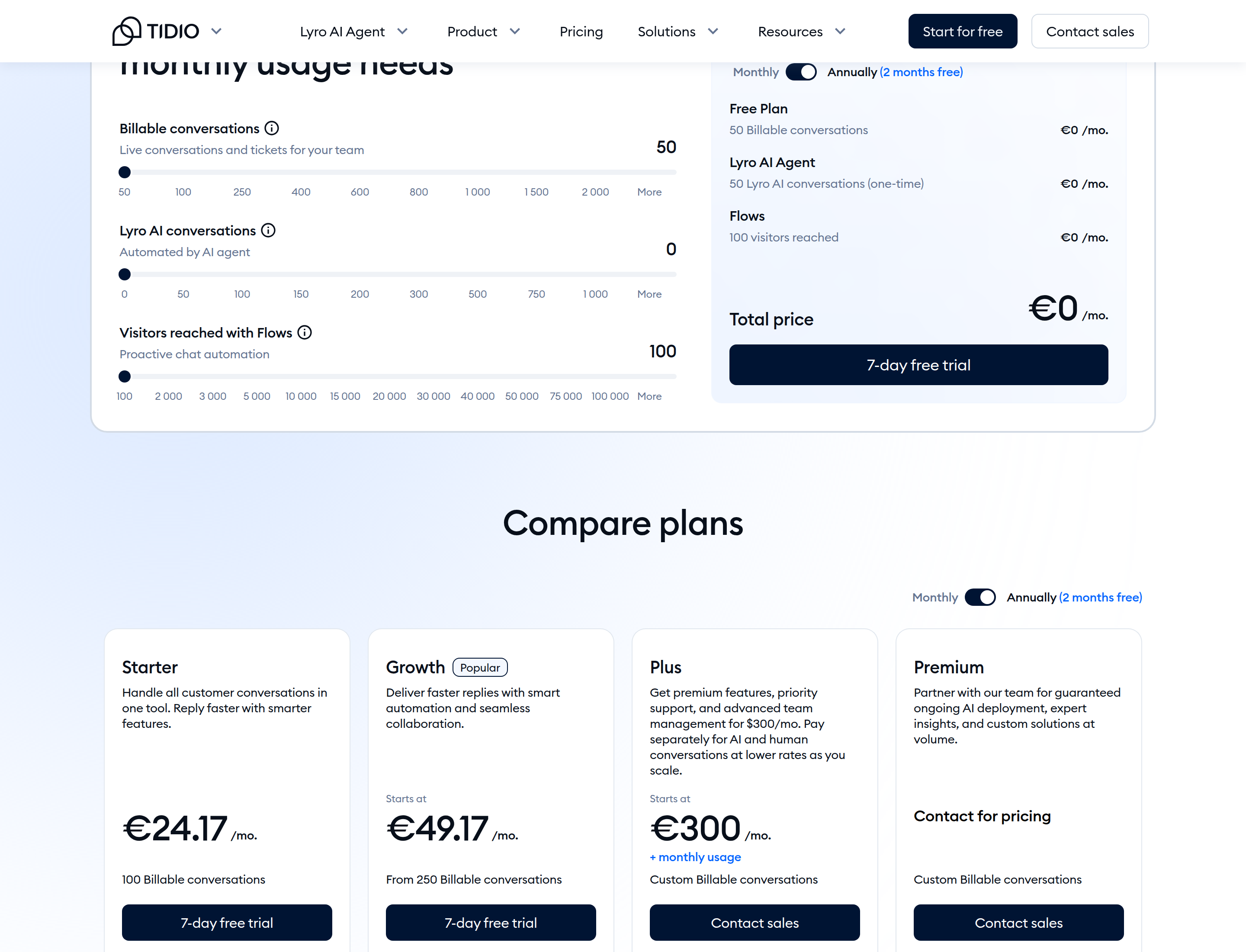
Tidio bills two different things separately. Billable conversations are human-handled chats and tickets. Lyro AI conversations are interactions the AI agent replies to. You can buy either without the other, and most teams end up on both meters.
Here is the human-support ladder in full — the seven Growth steps are the part no plan card shows you:
| Plan | Billable conversations/mo | Price/mo | Cost per conversation |
|---|---|---|---|
| Free | 50 | $0 | — |
| Starter | 100 | $29 | $0.290 |
| Growth | 250 | $59 | $0.236 |
| Growth | 400 | $89 | $0.223 |
| Growth | 600 | $129 | $0.215 |
| Growth | 800 | $159 | $0.199 |
| Growth | 1,000 | $179 | $0.179 |
| Growth | 1,500 | $249 | $0.166 |
| Growth | 2,000 | $349 | $0.175 |
| Plus | 5,000 | from $300 + usage | quote-only |
| Premium | 10,000+ | contact for pricing | quote-only |
Two things follow. First, budgeting from the $59 headline is how teams end up 5.9× over plan; if you handle 2,000 conversations a month you are on a $349 plan, and nothing on the pricing card tells you that in advance. Second — and this is the fairer reading — the per-conversation rate improves as you climb, from $0.290 on Starter to about $0.166 at the 1,500 step. Tidio is not penalising growth. It is simply advertising the floor and letting the slider do the disclosing.
Annual billing takes two months off: Starter's $29 becomes $24.17/mo and Growth's $59 becomes $49.17/mo, a shade under 17% off. That is a real discount, but it is also a twelve-month commitment — see the renewal section before you take it.
What Lyro actually costs
Lyro is Tidio's AI support agent, and it is the reason most people are on this page. It reads your help content, answers customers directly, and hands off to a human when it cannot. It runs on its own ladder:
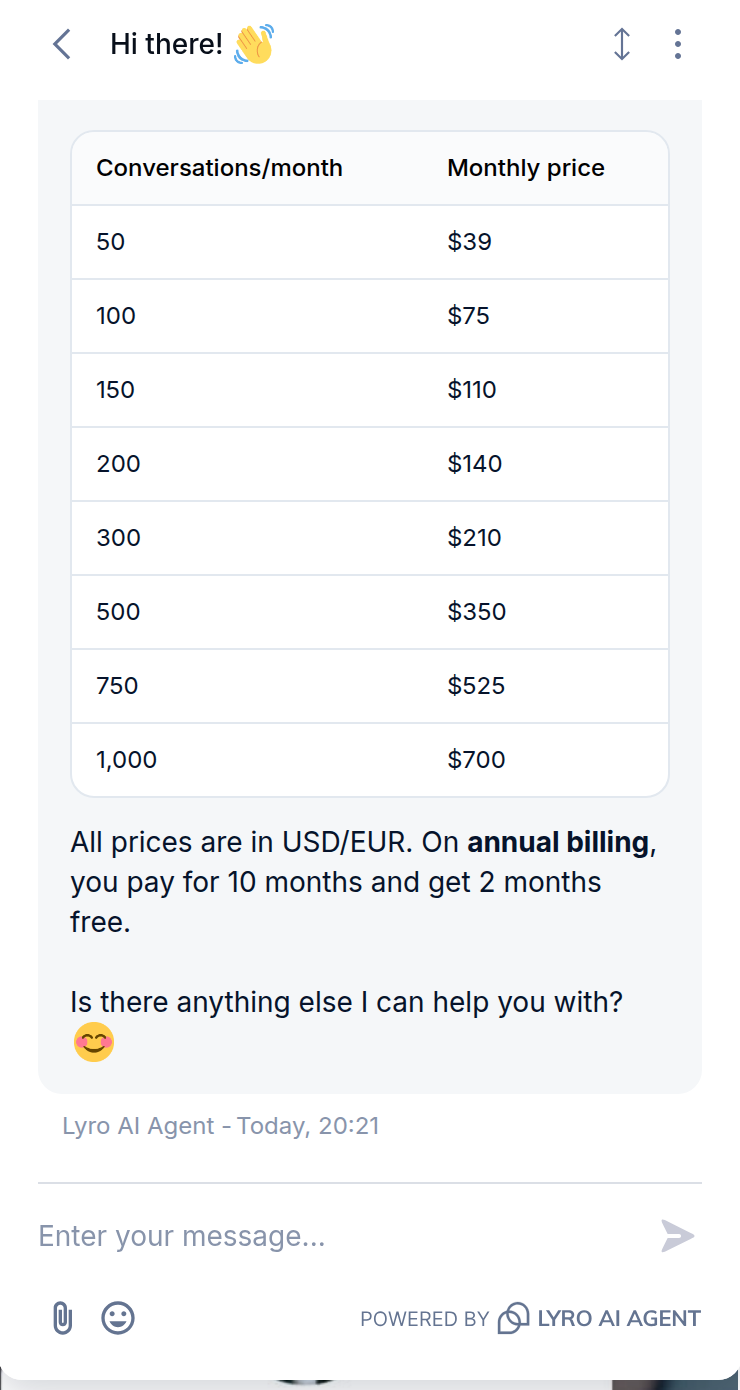
| Lyro AI conversations/mo | Price/mo | Cost per AI conversation |
|---|---|---|
| 50 (one-off, free plan) | $0 | — |
| 50 | $39 | $0.780 |
| 100 | $75 | $0.750 |
| 150 | $110 | $0.733 |
| 200 | $140 | $0.700 |
| 300 | $210 | $0.700 |
| 500 | $350 | $0.700 |
| 750 | $525 | $0.700 |
| 1,000 | $700 | $0.700 |
The rate flattens at $0.70 per Lyro conversation from 200/month upward and never improves after that. There is no volume break between 200 and 1,000 — useful to know before you negotiate, because the list price gives you nothing to negotiate toward until you are into Plus or Premium territory.
Set against a human, that number is genuinely good, and we can say so using Tidio's own arithmetic. Tidio's savings calculator assumes a US support rep on a $42,000 salary costs $6.73 per conversation answered. At $0.70, Lyro comes in about 90% cheaper per conversation than the benchmark Tidio itself publishes. For high-volume, repetitive, FAQ-shaped support, that gap is the whole argument for deploying an AI agent, and it is not a close call.
We asked Lyro what Lyro costs
Rather than take the rate card's word for it, we opened the chat widget on tidio.com — which Tidio runs on Lyro itself — and asked the agent directly. It returned the full ladder, unprompted, and it matches the pricing payload above line for line: $39 at 50 conversations, $140 at 200, $700 at 1,000. When a vendor's own AI agent independently reproduces the numbers we extracted, that is about as good as pricing verification gets.
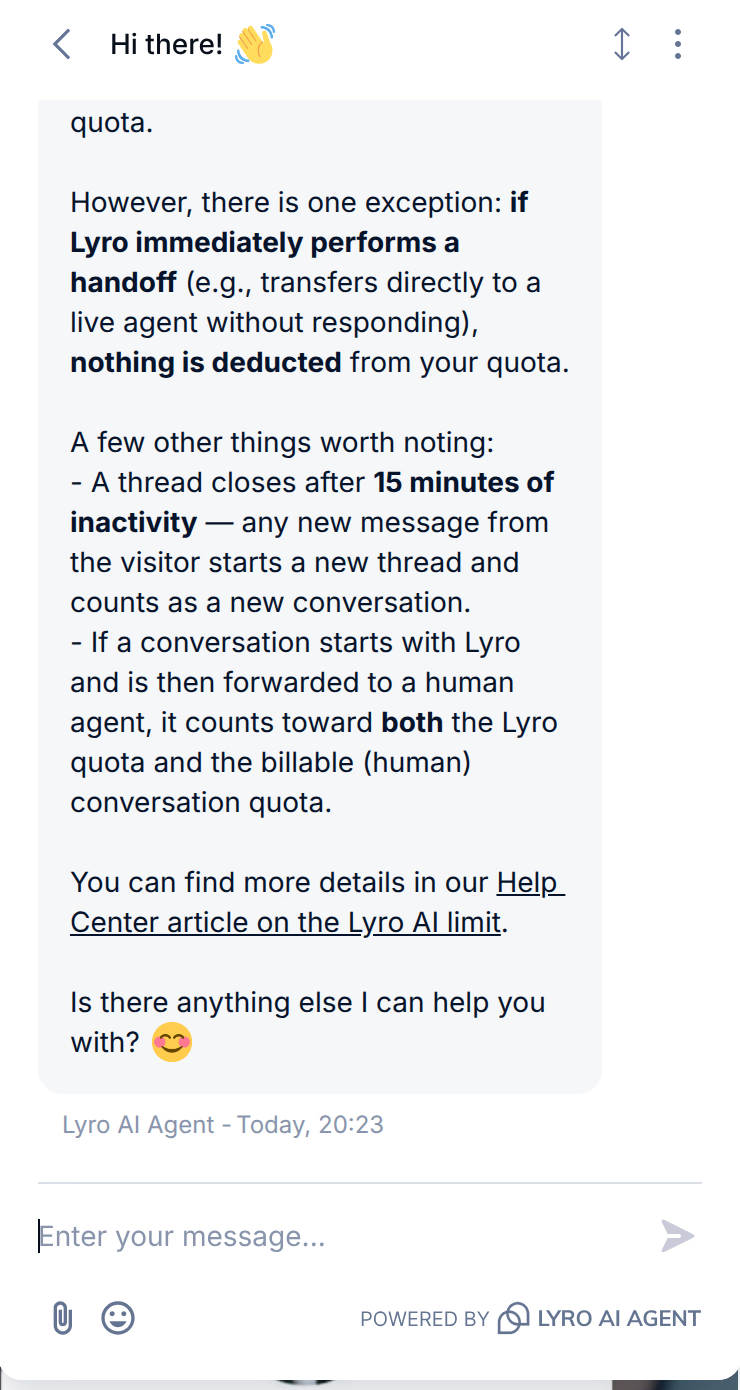
We then asked the question that decides the bill: does Lyro charge for conversations it cannot resolve? Its answer — "if Lyro engages with the visitor, even if it ultimately can't resolve the issue, that conversation does count toward your quota" — is confirmed by Tidio's own documentation. The Help Center article The Lyro AI agent limit (updated 17 June 2026) sets out three rules worth knowing before you model a budget:
- A conversation is counted the first time Lyro replies in a new thread — not when it resolves anything. Lyro can reply many times in one thread for a single unit.
- An immediate handoff costs nothing. If Lyro transfers to a human without responding, nothing is deducted. This is a genuine point in Tidio's favour and it is easy to miss.
- A thread closes after 15 minutes of inactivity. Any new message after that starts a fresh thread and is counted again. A customer who steps away and comes back twenty minutes later costs you two conversations, not one.
That last rule is the one we would flag hardest. Support conversations are not continuous — people go and look up an order number, or answer the door. If your traffic is bursty and asynchronous, your billed conversation count can run meaningfully ahead of your ticket count, and nothing on the pricing page tells you that.
67%, 55%, or 50%? Tidio's resolution rate, three ways
Here is where a cost-first read earns its keep. Lyro is billed per conversation it replies to, not per conversation it resolves. Tidio's own definition is explicit: a Lyro AI conversation is "a customer interaction that has at least one reply from our AI support agent." If Lyro answers, tries, and hands the customer to a human anyway, that conversation is billed — and then a person works it too.
So your true cost per resolved ticket is $0.70 divided by the resolution rate. And Tidio publishes three different resolution figures:
| Rate | Where it comes from | Effective cost per resolution |
|---|---|---|
| 67% | Tidio's headline claim: Lyro "boosts your resolution rate to 67% on average — often even higher," and "users automate around 67% of customer inquiries." | $1.04 |
| 55% | The assumption inside Tidio's own savings calculator: "Lyro AI's average response rate of 55%." | $1.27 |
| 50% | The contractual floor — a "guaranteed 50% Lyro AI resolution rate," available on Premium only. | $1.40 |
None of these numbers is wrong, and none of them is hidden — all three sit in Tidio's own public materials. But they are not interchangeable, and the gap between them is the interesting part: Tidio markets 67%, models 55% when it calculates your savings for you, and guarantees 50%, on one plan. The number a vendor uses in its own arithmetic is usually the most conservative one it believes. Budget at 55%, treat 67% as the good-case ceiling, and read 50% as the floor you can hold someone to.
This also reframes the comparison buyers usually make. Intercom's Fin agent charges $0.99 per resolution and only bills when it resolves. Lyro at $0.70 per conversation works out to roughly $1.27 per resolution at Tidio's own 55% assumption — slightly more than Fin per successful outcome, on list price. That is not a reason to pick Fin: Tidio's human-support seats are dramatically cheaper, the two products bundle differently, and few teams buy an AI agent in isolation. But if you are comparing AI agents purely per-resolution, compare $1.27 to $0.99, not $0.70 to $0.99.
Where the bill surprises people
Tidio is a well-liked product. It holds 4.7 out of 5 across 590 Capterra reviews, and Tidio's own site cites 4.6 on G2 and 4.7 on both the Shopify and WordPress marketplaces. Users consistently praise how fast the widget goes live and how little work basic live chat takes to run. That is the majority experience and it should anchor your expectations of the software itself.
The complaints cluster somewhere else: billing. Our review corpus records eight distinct cost surprises for Tidio, two of them rated critical, and they are all about what happens after you sign rather than what the product does. The recurring themes, drawn from dated user reports:
- Renewal increases with little notice. Multiple reviewers document year-over-year jumps — one itemises 27% in 2023, 32% in 2024 and 112% in 2025 — arriving at or near the billing date.
- Automatic upgrades that aren't symmetric. Usage rising above your tier moves you up; usage falling back does not reliably move you down.
- Annual charges are effectively non-refundable once processed, and auto-renewal is on by default.
Weigh this proportionately. These reports concentrate on Trustpilot, where Tidio's rating is 1.6 across just 24 reviews — a small, self-selecting sample that skews toward people with a billing grievance, and not a fair summary of the product. But "small sample" is not "no signal," and the specific, dated, repeated nature of the pricing complaints is exactly the kind of thing a pricing guide exists to surface. The practical response is cheap: diary your renewal date, open the conversation about 30 days before it, and keep a card off the file on free accounts. Do that and most of the documented downside disappears.
Who Tidio is right for
Buy it if you are a small or mid-sized team — especially ecommerce — with high-volume, repetitive questions, you want a widget live this week rather than this quarter, and your support load sits comfortably inside the Growth ladder. At 250–1,500 conversations a month with Lyro deflecting the FAQ layer, the economics are hard to argue with.
Look elsewhere if your support is low-volume but high-complexity, where an AI agent that resolves half of contacts saves little and a per-conversation meter just adds cost; or if you need enterprise procurement guarantees, in which case you are in quote-only territory and should be comparing negotiated rates, not list prices.
The one thing to model before you commit: your real monthly conversation count on both meters, priced at the step you will actually land on rather than the one on the card. Everything else about this decision is downstream of that number.
Tidio partner link, in full: https://affiliate.tidio.com/vs1tu6da6s4g